
A French drain is a gravel-filled trench containing a perforated pipe that redirects groundwater and surface water away from specific areas, while a dry well is an underground reservoir that collects and stores excess water until it percolates into the surrounding soil. Both are subsurface drainage systems, but they function differently: French drains move water horizontally through gravity drainage, whereas dry wells collect water vertically for soil absorption.
Why Understanding Drainage System Types Matters for Property Water Issues
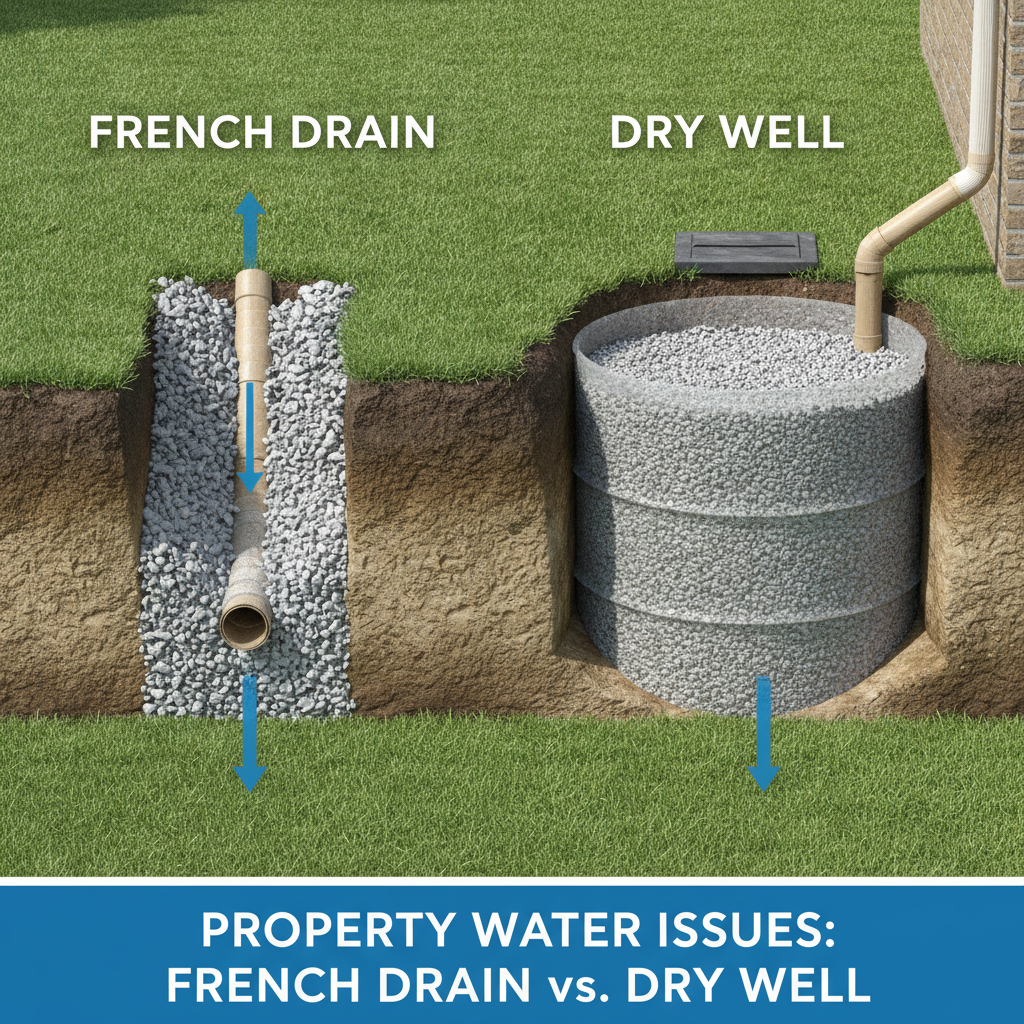
Effective stormwater management prevents foundation damage, basement waterproofing failures, and yard flooding solutions. According to the American Society of Landscape Architects (2024), improper drainage causes approximately 60% of foundation problems in residential properties. Choosing between a French drain or dry well for yard drainage requires understanding how each addresses standing water removal and moisture control in different soil conditions.
What Is a French Drain? Key Characteristics and Components
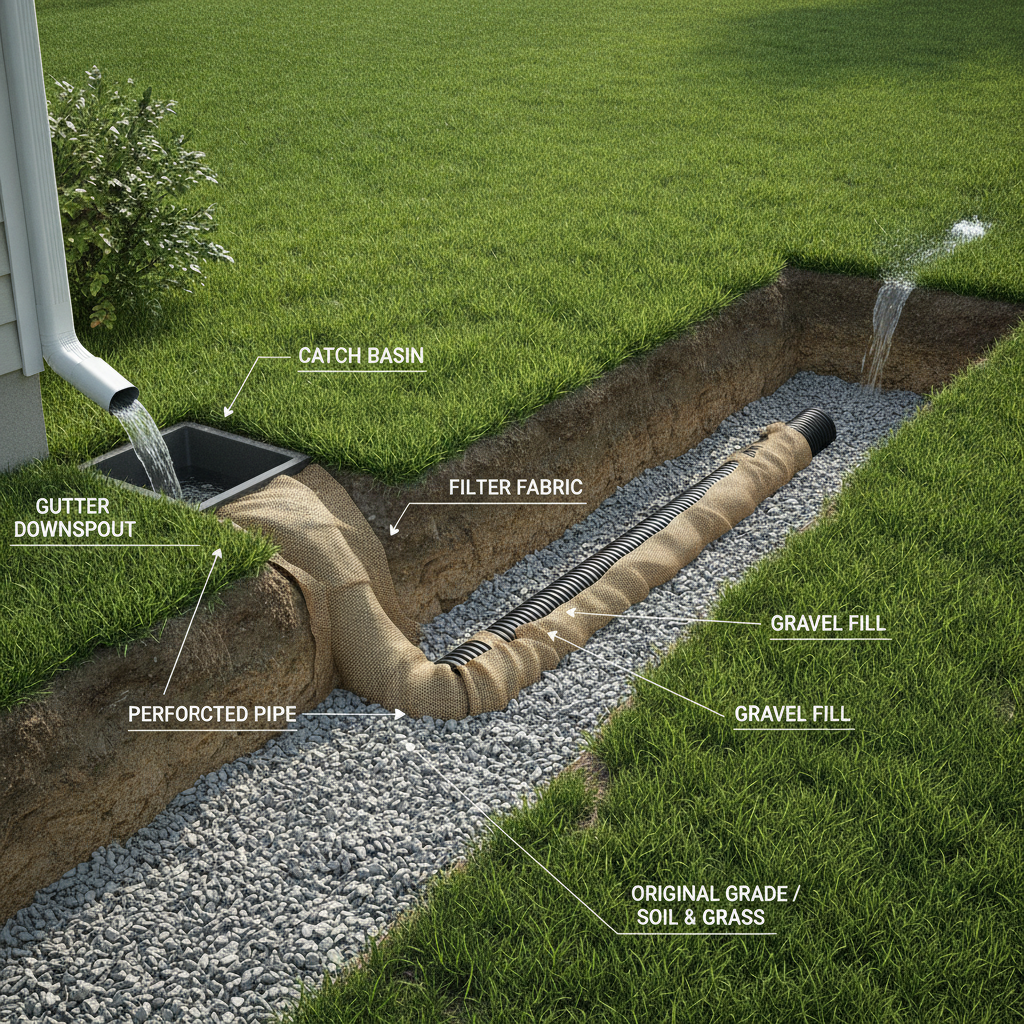
Named after French engineer Henry Flagg French who popularized the design in 1859, a French drain consists of five essential drainage system components:
- Drainage trench: Excavation typically 18-24 inches deep with a 1% slope grade for gravity drainage
- Geotextile fabric: Landscape fabric or filter fabric preventing soil infiltration
- Aggregate layer: Drainage stone or gravel bed providing water flow capacity
- Perforated pipe: Corrugated pipe, PVC pipe, or slotted pipe (commonly 4-inch drain pipe)
- Backfill material: Additional drainage stone topped with soil or landscaping
The subsurface drainage system works through continuous water diversion techniques along its entire length. Water enters through drainage holes, travels through the corrugated drainage tubing, and exits at a designated discharge point such as a catch basin, pop-up emitter, or dry creek bed.
What Is a Dry Well? Understanding Underground Water Storage Systems
A dry well (also called a seepage pit, leach pit, or soakaway) is a buried tank or drainage chamber filled with drainage stone that temporarily stores rainwater. The drywell system typically measures 3-4 feet in diameter and 3-6 feet deep, depending on water retention needs and percolation rate.
Key characteristics distinguishing dry wells include:
- Centralized collection: Water catchment occurs at a single underground location rather than along a linear path
- Infiltration focus: Designed specifically for soil percolation and groundwater recharge
- Storage capacity: Acts as an underground reservoir managing large water volumes from downspout drainage
- Permeable walls: Drainage holes throughout allow 360-degree water absorption capacity
- Minimal footprint: Requires less excavation area compared to drainage trench systems
How Dry Wells Work: The Infiltration Process
According to the Environmental Protection Agency’s stormwater control guidelines (2023), dry wells manage runoff through three stages. First, water flows from gutters or surface drains through solid drainage pipe into the infiltration basin. Second, the gravel sump temporarily stores water in void spaces between the aggregate. Third, stored water gradually infiltrates through drainage holes into permeable soil based on the site’s percolation pit capacity.
French Drain vs Dry Well: Direct Comparison of Drainage Solutions
| Feature | French Drain | Dry Well |
|---|---|---|
| Primary Function | Water redirection and conveyance | Water collection and infiltration |
| Coverage Area | Linear (perimeter drain, curtain drain along foundation) | Localized (single point such as downspout or catch basin system) |
| Installation Depth | 18-24 inches typical | 3-6 feet depending on water table management needs |
| Soil Requirements | Works in various conditions; less dependent on soil drainage capacity | Requires permeable soil; ineffective in clay soil |
| Drainage Installation Cost | $25-50 per linear foot (2024) | $1,000-3,000 per unit installed (2024) |
| Maintenance Requirements | Flush pipe every 3-5 years; inspect for clogging issues | Clean sediment every 5-7 years; check drainage grate |
| Drainage System Lifespan | 30-40 years with proper drainage system maintenance | 20-30 years; shorter in high-sediment environments |
Common Misconceptions About French Drains and Dry Wells
Myth: French drains and dry wells serve identical purposes.
Reality: French drains excel at continuous water flow management along foundations or retaining walls, while dry wells specialize in point-source water collection like gutter drainage solutions.
Myth: You must choose only one drainage system type.
Reality: Combining French drain with dry well systems often provides optimal stormwater management. A footer drain or foundation weeping tile can terminate in a dry well, creating a French drain ending in dry well configuration.
Myth: Dry wells work in all soil types.
Reality: According to the National Association of Home Builders (2024), dry wells require minimum percolation rates of 10-60 minutes per inch. Clay soil or areas with high water table levels cannot support dry well as French drain outlet designs.
Myth: DIY French drain vs dry well installation costs are similar.
Reality: French drains typically allow easier DIY installation using flexible drain pipe and standard excavation tools, while dry wells often require specialized drainage chambers and deeper excavation by drainage contractors.
When to Use a French Drain: Best Applications for Water Diversion
Choose French drains for these yard water problems:
- Foundation drainage: Preventing basement waterproofing failures and hydrostatic pressure against basement or crawl space walls
- Hillside property: Managing surface water control on sloped terrain where gravity drainage naturally moves water downward
- Wet yard solutions: Addressing waterlogging and soggy lawn fixes across broad landscape areas
- Retaining wall protection: Relieving moisture buildup causing soil saturation and structural pressure
- Perimeter drain systems: Creating curtain drains around property boundaries for comprehensive flood mitigation
When to Use a Dry Well: Ideal Scenarios for Infiltration Systems
Dry wells provide optimal drainage efficiency comparison in these situations:
- Downspout drainage: Managing concentrated rainwater from roof drainage culvert discharge points
- Permeable soil conditions: Sites with documented soil permeability supporting rapid percolation rates
- Limited discharge options: Properties lacking suitable areas for French drain outlet placement
- Localized standing water: Addressing specific low spots requiring targeted water removal systems
- Environmental compliance: Meeting municipal stormwater pit requirements for on-site water management
Combining French Drain and Dry Well Systems
According to HomeWard Environmental, connecting French drain to dry well creates a comprehensive drainage solution addressing both conveyance and storage. The subsurface drainage trench collects distributed moisture while the seepage pit provides terminal infiltration capacity. This French drain dry well combination system works effectively when the water table permits adequate absorption and soil erosion control remains stable during heavy rainfall events.
Installation best practices for combination systems include sizing the infiltration trench proportionally to upstream collection area, installing area drain access points for maintenance, and using solid drainage pipe for the final connection to prevent premature sediment accumulation in the dry well chamber.
French Drain and Dry Well Installation Cost Comparison (2024)
Professional installation varies by region and soil conditions. French drain systems average $25-50 per linear foot including flexible drain pipe, aggregate, and geotextile fabric. A typical 50-foot perimeter drain costs $1,250-2,500. Dry well installations range from $1,000-3,000 per unit depending on depth, drainage chamber type, and excavation complexity. Properties requiring both systems can expect total drainage installation cost of $3,000-7,000 for comprehensive moisture mitigation.
Choosing Between French Drain or Dry Well for Your Property
Effective water management comparison begins with site assessment. Test soil drainage capacity by digging a 12-inch hole, filling with water, and measuring percolation time. If water drains within 24 hours, permeable soil supports dry wells. For clay soil or slow drainage, French drains provide superior drainage alternatives. Consider consulting drainage contractors for properties with complex topography, existing sump pump systems, or commercial French drain or dry well system requirements.