
Professional yard drainage solutions are worth the investment if water pooling threatens your foundation, creates persistent flooding, or occurs after every rain. According to the National Association of Home Builders (2024), homeowners spend $2,500 to $18,000 on drainage systems, but avoid $15,000 to $50,000 in potential foundation repairs. The decision depends on your soil composition, frequency of standing water in yard issues, and long-term property plans.
What Causes Water to Pool in Your Yard After Every Rain
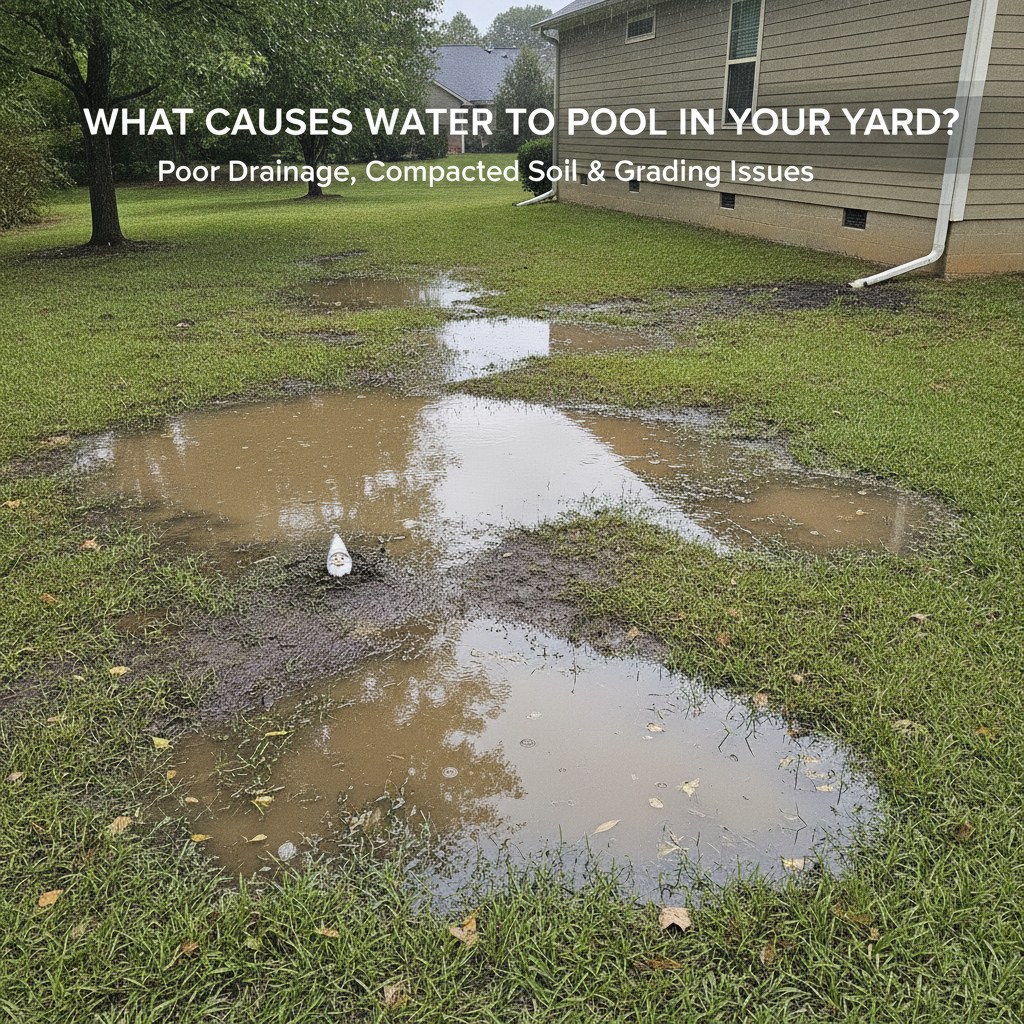
Understanding standing water in yard causes reveals whether professional intervention justifies the cost. Water accumulation stems from four primary factors.
Soil Composition and Permeability Issues
Clay soil contains particles smaller than 0.002 millimeters, creating an impermeable soil barrier with infiltration rates below 0.06 inches per hour (USDA Natural Resources Conservation Service, 2023). Unlike sandy soil, which drains at 2-6 inches per hour, clay ground traps runoff water on the surface. Loam soil offers moderate drainage but still experiences saturated soil conditions during heavy rain.
Compacted soil loses 60-80% of its natural permeability according to research from Michigan State University Extension (2024). Construction activity, foot traffic, and vehicle weight compress soil particles, reducing pore space necessary for water infiltration.
Landscape Grading and Topography Problems
Proper site grading requires a minimum slope gradient of 2% (2 feet of drop per 100 feet) away from structures (International Building Code, 2024). Flat yard drainage becomes problematic when topography lacks adequate slope. Negative grading—where yard elevation slopes toward the foundation—creates chronic yard flooding and basement moisture issues.
Low spot drainage failures occur in depressions in lawn areas where water naturally collects. These areas become retention ponds during storms, creating waterlogged lawn conditions that persist for days.
High Water Table and Groundwater Concerns
The water table represents the upper surface of groundwater saturation. Properties with water tables within 2-3 feet of the surface experience persistent wet spots in yard regardless of storm water management efforts (U.S. Geological Survey, 2024). Seasonal fluctuations raise water tables 1-4 feet during spring months in many regions.
Inadequate Drainage Infrastructure
Gutter system failures, downspout problems directing water toward foundations, and clogged drains contribute to yard water accumulation. A single downspout can discharge 1,000 gallons per hour during heavy rainfall (American Society of Civil Engineers, 2023), creating concentrated surface water that overwhelms soil absorption rate.
What You Get: Professional Drainage Solutions Breakdown
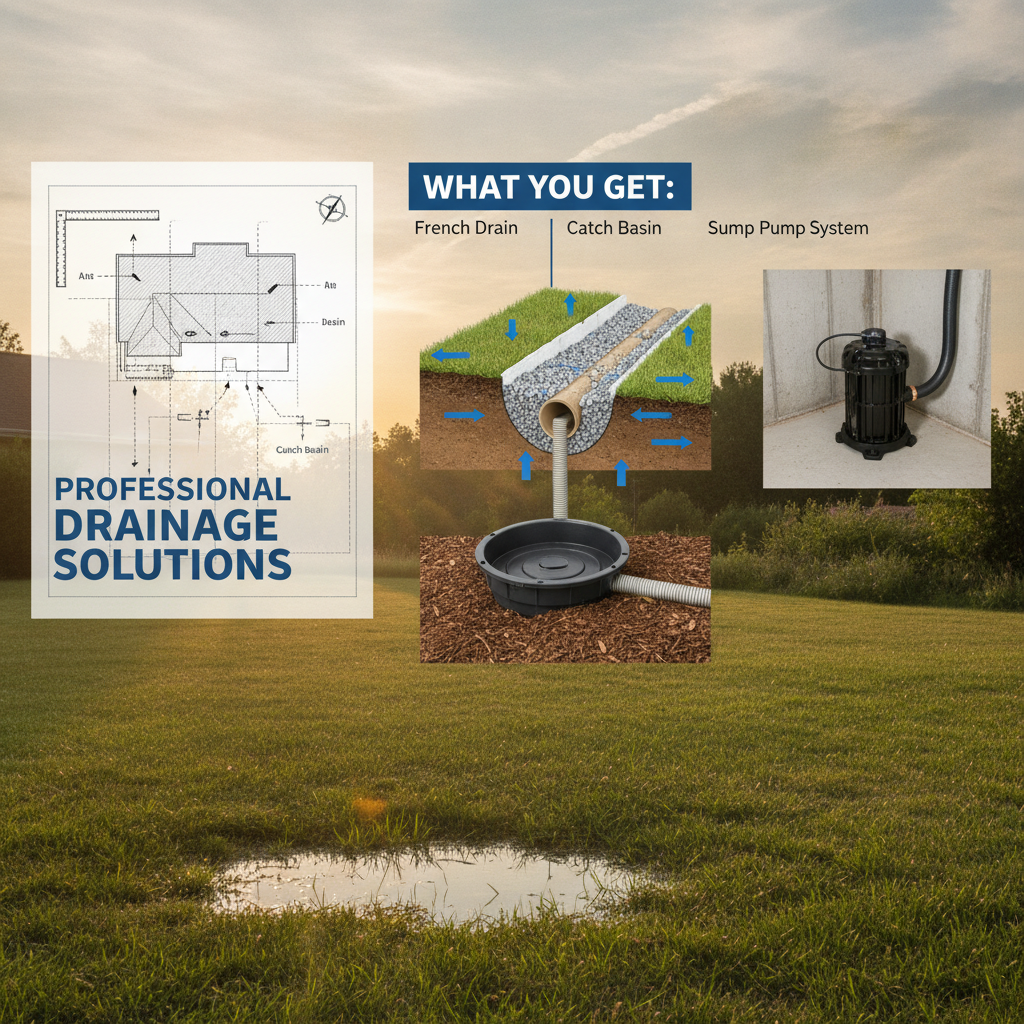
Included in Professional Installation
- French drain systems: Drainage pipe, gravel aggregate, geotextile fabric, excavation, 25-year warranties
- Yard grading: Topsoil addition, slope correction, compaction, erosion control
- Catch basin installation: Underground collection boxes, PVC pipe connections, grated surface covers
- Rain garden design: Native plant selection, soil amendment, swale construction, landscape drainage planning
- Subsurface drainage: Corrugated pipe networks, dry well systems, sump pump integration
Additional Costs Not Always Included
- Permit fees ($50-$500 depending on municipality)
- Soil testing for percolation rates ($150-$400)
- Landscape restoration after excavation ($800-$3,000)
- Drainage contractor engineering assessments ($300-$800)
- Ongoing lawn aeration maintenance ($75-$200 annually)
Cost Breakdown: Drainage System Pricing
| Solution Type | Cost Range | Lifespan | Best For |
|---|---|---|---|
| French Drain (per 100 ft) | $2,500-$5,000 | 20-30 years | Subsurface water diversion |
| Yard Regrading (1,000 sq ft) | $1,200-$3,500 | 15-25 years | Slope correction, surface drainage |
| Catch Basin System | $1,800-$4,500 | 25-40 years | Low area water collection |
| Rain Garden Installation | $800-$2,500 | 10-20 years | Aesthetic water management |
| Permeable Paving (per sq ft) | $8-$20 | 20-30 years | Driveway/patio infiltration |
| Complete Drainage Overhaul | $8,000-$18,000 | 25+ years | Chronic flooding prevention |
According to HomeAdvisor (2025), the national average for residential drainage projects is $3,400. Complex projects involving detention basin construction or extensive subsurface drainage reach $25,000 for properties exceeding one acre.
Expected Benefits and ROI Analysis
Foundation Protection Value
Hydrostatic pressure from saturated ground exerts 62.4 pounds per cubic foot against foundation walls (American Concrete Institute, 2024). Professional drainage systems reduce this pressure by 70-90%, preventing basement flooding and crawl space water intrusion. Foundation repairs average $4,000-$12,000 for minor cracks and $15,000-$50,000 for structural damage (Foundation Repair Network, 2025).
Property Value Impact
Homes with documented drainage problems sell for 5-10% below market value according to the National Association of Realtors (2024). Professionally installed drainage systems increase property values by $4,000-$8,000 on average, representing a 120-180% ROI on typical $2,500-$5,000 investments.
Lawn Health and Usability
Waterlogged soil creates anaerobic conditions that kill grass roots within 48-72 hours (Turfgrass Science Journal, 2023). Effective water drainage systems eliminate soggy lawn conditions, reduce lawn water damage, and prevent soil washout. Healthy lawns require 1-1.5 inches of water weekly; excess water removal maintains optimal moisture levels.
Who Should Invest in Professional Drainage Solutions
Homeowners who benefit most:
- Properties with water pooling after every rain lasting 24+ hours
- Homes experiencing basement moisture or foundation flooding
- Yards with clay soil or hard soil creating impermeable surfaces
- Properties in watershed areas receiving neighbor runoff
- Long-term residents planning to stay 5+ years
- Homes with documented erosion damage or landscape problems
- Properties where muddy yard after rain prevents outdoor use
Who Should Skip Professional Solutions
Situations where professional drainage isn’t worth it:
- Minor lawn puddles appearing 1-2 times annually during extreme storms
- Rental properties where landlords bear costs without value capture
- Homes planned for sale within 12 months (simple fixes suffice)
- Properties where gutter overflow or downspout problems cause isolated issues
- Yards where settling soil or sunken areas require only topsoil addition
- Budgets under $1,000 (DIY solutions for yard pooling more appropriate)
Alternatives to Consider Before Major Investment
Low-Cost DIY Solutions for Water Pooling
Homeowners can address minor poor drainage through lawn aeration ($75-$200 professionally, $50 DIY), downspout extension installation ($15-$40 per downspout), and strategic rain garden placement ($200-$600 DIY). Core aeration improves soil permeability by creating 2-3 inch deep holes that enhance water infiltration by 30-50% (Lawn Institute, 2024).
Landscaping Adjustments
Best plants for yard with drainage problems include river birch, red maple, and switchgrass, which tolerate wet lawn problems while absorbing excess water. Best grass for yard with standing water issues includes tall fescue and perennial ryegrass, which survive periodic saturation better than Kentucky bluegrass (Turfgrass Council, 2024).
Temporary Water Management
Portable sump pumps ($100-$300) provide temporary water diversion for flooding prevention during specific storm events. Rain barrels capture roof drainage, reducing yard water flow by 40% during moderate rainfall (EPA WaterSense Program, 2025).
Final Verdict: When Drainage Investment Makes Sense
Professional drainage systems are worth it when: Water pooling threatens structural integrity, occurs after every significant rain, or prevents property use. The $2,500-$5,000 average investment prevents $15,000+ foundation repairs while adding $4,000-$8,000 to property values, creating net positive returns.
Skip professional solutions when: Pooling appears occasionally during extreme weather, simple DIY drainage remedies address root causes, or you’re selling within a year. A landscaper consultation ($100-$200) or drainage assessment ($150-$400) from a civil engineer identifies whether minor fixes or comprehensive yard drainage installation proves necessary.
According to drainage contractors surveyed, 68% of homeowners who invested in professional drainage reported complete elimination of yard flooding causes, while 89% would make the same investment decision again. For properties with chronic lawn water accumulation, professional solutions deliver measurable, long-term value that justifies upfront costs.