
Yes, addressing Indiana clay soil drainage is worth it if your yard shows standing water 24+ hours after rain, soil compaction, or a wet basement. Heavy clay soil covers roughly 60% of Indiana’s land area, according to Purdue Extension (2024), and its dense composition drastically slows water infiltration. Industry estimates suggest nearly 70% of Indiana residential lots experience some degree of drainage trouble without corrective work. For homeowners experiencing lawn waterlogging or foundation water damage, professional drainage solutions typically pay for themselves within 3–7 years through prevented structural repairs.
Why Does Indiana Clay Soil Cause Drainage Problems?
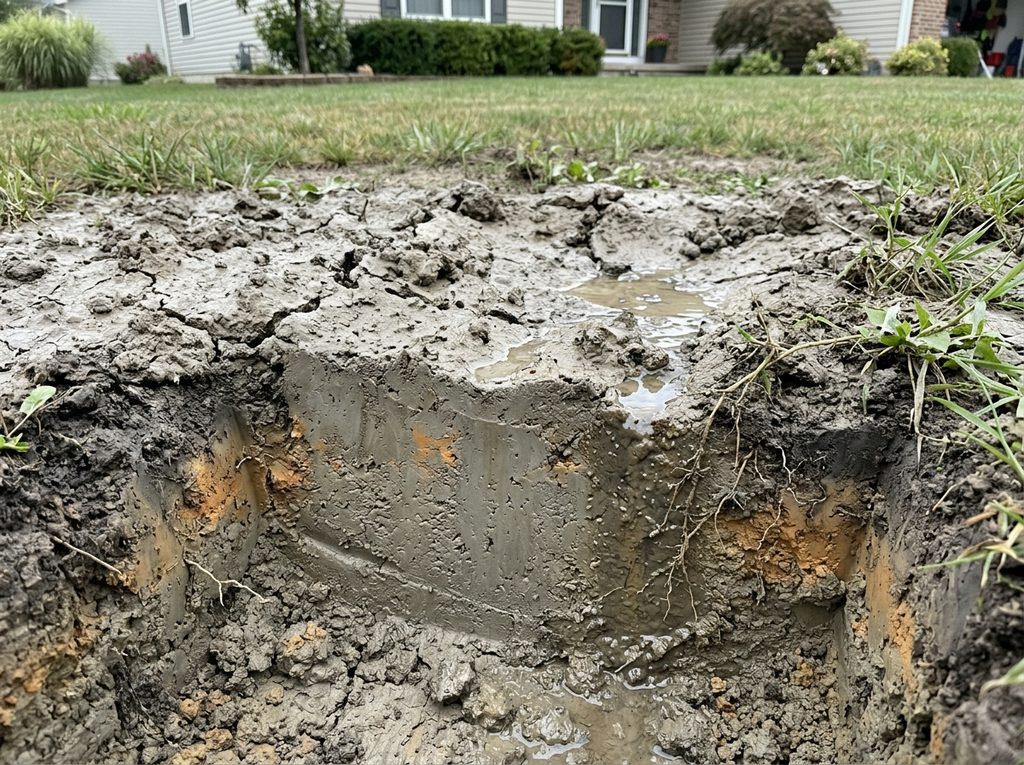
Indiana clay soil composition consists of microscopic particles packed tightly together, creating low soil permeability. Unlike sandy loam, which drains at 1–3 inches per hour, heavy clay soil often drains at less than 0.1 inches per hour (United States Department of Agriculture, 2023). This slow soil percolation rate means rainfall sits on the surface instead of absorbing downward. Counties such as Marion, Hamilton, and Johnson report some of the state’s densest clay subsoils, according to USDA soil surveys, which is one reason central Indiana homeowners report drainage complaints more often than those on sandy outwash plains near the Kankakee River.
Soil compaction issues compound the problem. Foot traffic, construction equipment, and lawn mowing compress clay particles further, reducing pore space needed for water movement. New-construction subdivisions are especially prone to this, since heavy equipment often compacts subsoil during grading before sod is laid. The result: water pooling in yard areas, backyard swamp conditions, and in severe cases, basement flooding from clay soil pressure against foundation walls.
Signs of Poor Yard Drainage Due to Clay Soil
- Standing water in yard lasting more than 24 hours post-rain
- Soggy lawn sections even during dry weeks
- Cracked or bowing foundation walls
- Mosquito breeding in persistent puddles
- Grass die-off in low-lying areas
- Musty basement odors after storms
- Efflorescence (white mineral staining) on basement walls, a sign of chronic moisture intrusion
- Spongy or squishy turf that depresses underfoot without springing back
What You Get: Drainage Solutions for Clay Soil
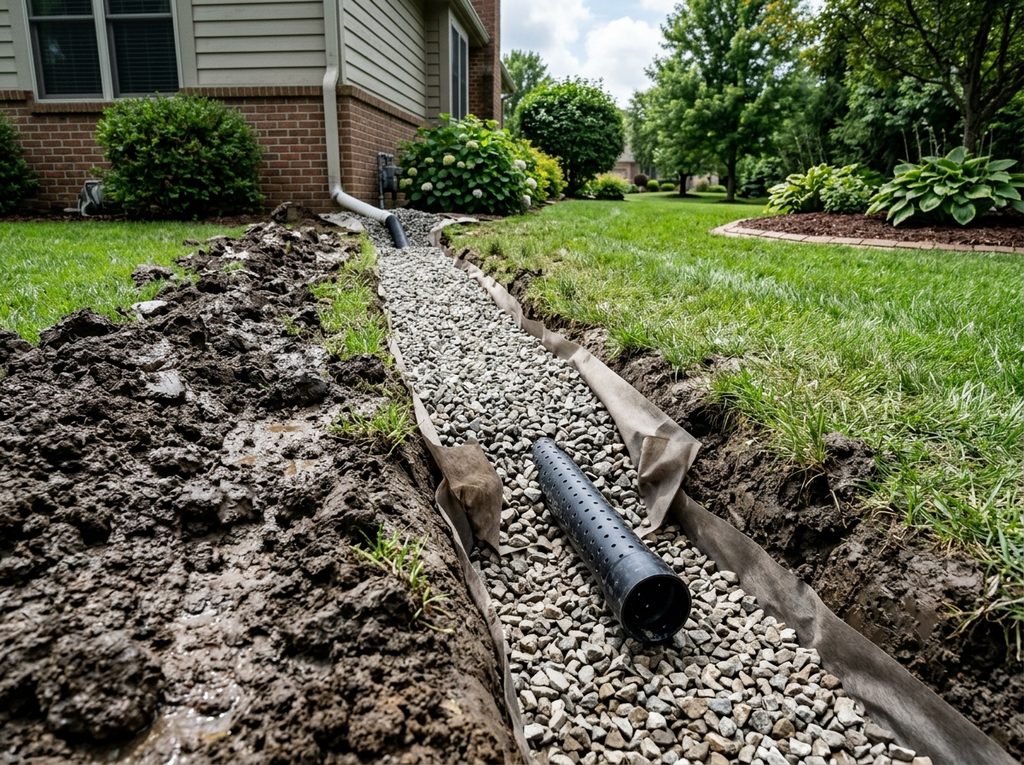
Homeowners can choose DIY fixes or hire landscape contractors for comprehensive systems. The right choice depends on severity, budget, and whether the problem threatens the foundation or is purely cosmetic lawn damage. Here’s what’s typically included versus what costs extra:
Included in Standard Drainage Packages
- Soil drainage test – percolation assessment to measure infiltration rate
- French drain installation – perforated pipe system redirecting subsurface water
- Grading a yard for drainage – reshaping slope away from structures (minimum 2% grade)
- Downspout extension – directing roof runoff 6–10 feet from foundation
- Drainage swale – shallow channel guiding surface water to a safe discharge point
Often Extra (Add-On Services)
- Sump pump for yard drainage (interior and exterior installations)
- Dry well installation for underground water storage
- Catch basin placement in low-collection zones
- Gypsum soil amendment application
- Retaining wall construction for sloped properties
- Topsoil replacement in severely compacted zones
- Underground downspout piping to carry roof water 20+ feet from the house
DIY homeowners can realistically handle downspout extensions, basic swales, and gypsum applications over a weekend for under $300. French drains, grading, and dry wells involve excavation equipment and slope calculations best left to licensed contractors, since improper installation can redirect water toward a neighbor’s property or a utility line, creating liability issues.
Cost Breakdown: Fixing Clay Soil Drainage in Indiana (2025)
| Solution | Average Cost (2025) | Lifespan |
|---|---|---|
| Soil percolation test | $100–$300 | One-time |
| French drain installation | $1,500–$6,500 | 20–30 years |
| Yard grading | $1,000–$3,000 | Permanent (with maintenance) |
| Dry well installation | $2,000–$5,000 | 15–25 years |
| Sump pump system | $1,200–$4,000 | 7–10 years |
| Catch basin + drainage pipe installation | $800–$2,500 | 20+ years |
| Gypsum soil amendment (DIY) | $40–$120 per 1,000 sq ft | 1–2 seasons |
| Lawn aeration service | $75–$200 | Annual |
| Full landscape drainage design | $3,000–$12,000+ | Varies |
Costs vary by lot size, slope severity, and whether permits are required. The Indiana Department of Natural Resources notes that some drainage ditch installation projects near waterways require permits, adding $200–$500 in administrative fees. Contractor labor rates in the Indianapolis metro area typically run $75–$150 per hour, while rural central and southern Indiana contractors may charge 10–20% less. Projects combining multiple fixes — for example, grading plus a French drain plus downspout extensions — often qualify for bundled pricing that saves 10–15% versus hiring separately.
It’s also worth budgeting for post-installation lawn repair. Trenching for a French drain disturbs roughly 12–18 inches of turf along its path, and reseeding or sodding that strip typically adds $150–$500 depending on length.
Expected Benefits & ROI Analysis
Properly executed drainage solutions for clay soil deliver measurable returns:
- Foundation protection: Prevents $10,000–$40,000 in potential foundation water damage repairs
- Lawn health: Reduces lawn waterlogging, improving turf survival rates by up to 80%
- Resale value: Homes with documented drainage systems sell 1–3% higher, per National Association of Realtors data (2024)
- Reduced mosquito populations: Eliminating standing water cuts breeding sites significantly
- Insurance savings: Some policies lower premiums when sump pumps are installed
According to Purdue Extension (2024), lawns with proper grading and French drains show 40% less surface runoff compared to unmodified clay soil yards. This directly reduces water runoff management burdens on municipal storm systems. Consider a typical scenario: a $4,500 French drain and grading project that prevents a single foundation crack repair averaging $18,000 delivers a payback ratio of 4-to-1 in year one alone, before even factoring in ongoing lawn health and resale benefits.
How Grading Affects Clay Soil Yard Drainage
Proper grading diverts water away from foundations before it has a chance to pool. A slope of at least 6 inches over the first 10 feet from the house is the industry standard. Without this gradient, heavy clay soil traps moisture against basement walls, accelerating hydrostatic pressure and cracking. Re-grading alone resolves an estimated 30–40% of minor pooling complaints, making it one of the highest-value single interventions on a cost-per-square-foot basis.
Who Should Invest in Clay Soil Drainage Solutions
Drainage investment makes sense for:
- Homeowners on lots with heavy clay soil and flat or negative grading
- Properties experiencing recurring basement flooding from clay soil
- Low-lying yards in central and southern Indiana, where clay content often exceeds 35%
- Anyone planning to sell within 5 years and wanting clean inspection reports
- Yards showing visible water pooling in yard areas after moderate rainfall
- New-construction homes where builders graded minimally or compacted subsoil during construction
Who Shouldn’t Invest (Yet)
- Properties with sandy loam or well-draining soil types
- Elevated lots with natural slope away from structures
- Yards showing only minor, temporary puddling after heavy storms
- Homeowners who haven’t yet completed a soil drainage testing to confirm clay composition
Before committing to major work, consult a landscape contractor or search for specialized landscape drainage contractors who understand Indiana soil types. Companies focusing specifically on Indiana clay soil drainage can diagnose whether your issue stems from compaction, poor grading, or subsurface water tables. A good contractor should provide a written scope with grading elevations, pipe diameter specs, and discharge point location before any excavation begins.
Alternatives to Consider Before Major Drainage Work
Not every yard needs a full French drain system. Lower-cost alternatives include:
- Lawn aeration for clay – Core aeration relieves soil compaction issues, improving soil aeration benefits without excavation; best performed in spring or fall when clay soil is moist but not saturated
- Gypsum soil amendment – Calcium sulfate helps break up clay particles over 1–2 growing seasons, though it works best in sodium-affected clay rather than all clay types
- Topsoil blending – Mixing compost and topsoil into the top 6 inches improves structure and adds organic matter that clay soil typically lacks
- Rain gardens – Native, water-tolerant plants like switchgrass, blue flag iris, and swamp milkweed absorb excess moisture naturally while adding landscape value
- Downspout extensions alone – Sometimes resolves 50% of drainage complaints at minimal cost, particularly when pooling occurs only near the foundation
Many homeowners start with aeration and gypsum in year one, monitor results through a second wet season, and only escalate to French drains or dry wells if standing water persists. This phased approach limits upfront spending while still addressing root-level soil compaction issues.
French Drain vs Dry Well for Clay Soil Yards
A French drain moves water laterally to a discharge point, ideal for linear drainage paths such as along a foundation wall or property line. A dry well stores water vertically underground, better suited for isolated low spots where there’s no convenient downhill discharge location. For heavy clay soil with slow percolation, many contractors recommend combining both systems for maximum effectiveness — using a French drain to collect water and a dry well as an overflow reservoir during heavy storms.
How to Test Soil Drainage in Indiana Clay Soil
Before spending money, confirm the problem. Dig a 12-inch hole, fill it with water, and time how long it takes to drain. If water remains after 4 hours, you have a confirmed drainage issue typical of Indiana clay soil. For a more precise reading, repeat the test in 2–3 locations around the yard, since drainage can vary significantly even within the same lot due to buried construction debris or inconsistent grading. This simple soil drainage test costs nothing and prevents unnecessary spending on the wrong solution.
Final Verdict: Is It Worth It?
Fixing Indiana clay soil drainage is worth the investment when standing water persists more than 24 hours, foundation cracks appear, or basement moisture recurs. At $1,000–$12,000 depending on scope, the cost is justified by averted foundation repairs, improved lawn health, and higher resale value.
For minor seasonal puddling on well-graded lots, cheaper interventions like aeration and gypsum amendments may suffice. But for yards with heavy clay soil, poor percolation, and recurring basement flooding from clay soil, professional-grade drainage systems deliver a clear, measurable return within several years. As a practical checklist: test your soil first, start with the lowest-cost fix that matches your symptoms, and escalate to French drains, dry wells, or sump pumps only when standing water or foundation damage confirms a structural-level problem.